

Spring has sprung, the flowers and blossom are poking through and I’ve even started to see frogspawn popping up in ponds. For most people this is a joyful time. We remember that winter does actually end and that brighter, longer and warmer days are possible. However, for 1 in 5 people across the UK, and, I’d wager, more in Oxfordshire, a dread looms around the corner. Hay fever season!
It is particularly bad in Oxford as we live in a valley, meaning the pollen collects, doesn’t blow away and so triggers all of the familiar and unpleasant symptoms even more intensely.
Hay fever, or seasonal allergic rhinitis, occurs when our immune system considers pollen an allergen. When this happens, a histamine response follows that causes the mucosal membranes to inflame, eyes to itch and noses to drip.
When you suffer from hay fever will depend upon which particular pollens you are allergic to. See the chart from the MET office for an idea of which plants pollen is around when. However, the vast majority of us (95%) suffer from grass pollen allergies.
Preventing hay fever

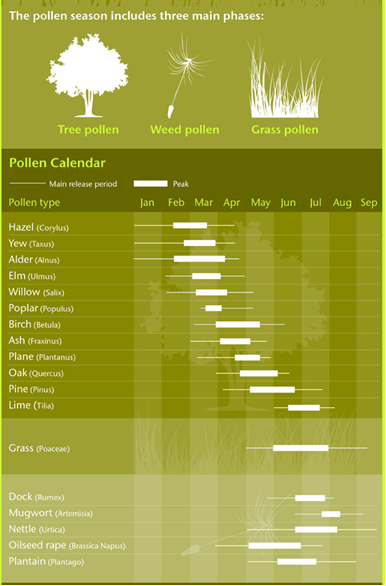
Source: The Met Office
There are a variety of strategies to minimise exposure to pollen, including;
- not going out on days when the pollen count is particularly high
- closing house and car windows when it is high
- wearing sunglasses and putting Vaseline around your nostrils
- doing saline washes of your nose
- washing clothes, hair and pillows after each exposure to pollen
- avoiding animals whose fur can trap and hold pollen
Medication includes anti-histamine pills and cortisol injections.
This is all very well. But if you are anything like most people, as soon as the sun comes out and the days draw out, the last thing you want is to stay cooped up inside whilst everyone else is outside enjoying it. So why is it that roughly 20% of people have a hypersensitivity to grass pollen? And are there ways in which we can cure it or at least nullify it without the drowsiness and other side effects of allopathic medicine? Well to be frank, the medical community does not have a concrete answer as to why. They merely point at pollen being the cause, without necessarily looking at why only some people are affected.
The role of the gut in hay fever
More recent research into hypersensitivity and inflammatory conditions, however, points towards the gut. 80% of our immune system is located in our gut. Our modern diet is highly inflammatory as well as being destructive to our gut bacteria. In such conditions our gut can become leaky. This allows inflammatory proteins into our bloodstream which cause a myriad of different issues. These issues include hypersensitivities to proteins that are similar to those coming through the gut. Some people with this will experience digestive disorders, however, that is not the case for everyone. You may have a ‘silent’ form. Common symptoms of poor gut health include, digestive issues, skin problems, mental-ill health and allergies. It is therefore necessary to heal the gut and modulate the immune system as well as calming the symptoms if you truly want to heal from hay fever.
My approach – treating hay fever
My approach to this is multi-faceted. It includes diet and lifestyle advice and a course of acupuncture and herbal medicine to boost the system and prevent and alleviate symptoms during the season. Diet changes are essential, to reduce the inflammatory foods and boost the healing foods. Exercise is important to modulate the immune system. Acupuncture has been shown to be effective for alleviating hay fever. It calms immune hypersensitivities and harmonises our body as a whole. Herbal medicine is also useful at reducing symptoms without causing drowsiness or other side-effects.
With hay fever season just around the corner it is important to get in front of it and start making the changes now.
See the British Acupuncture Council’s page for more information about how acupuncture can help.